
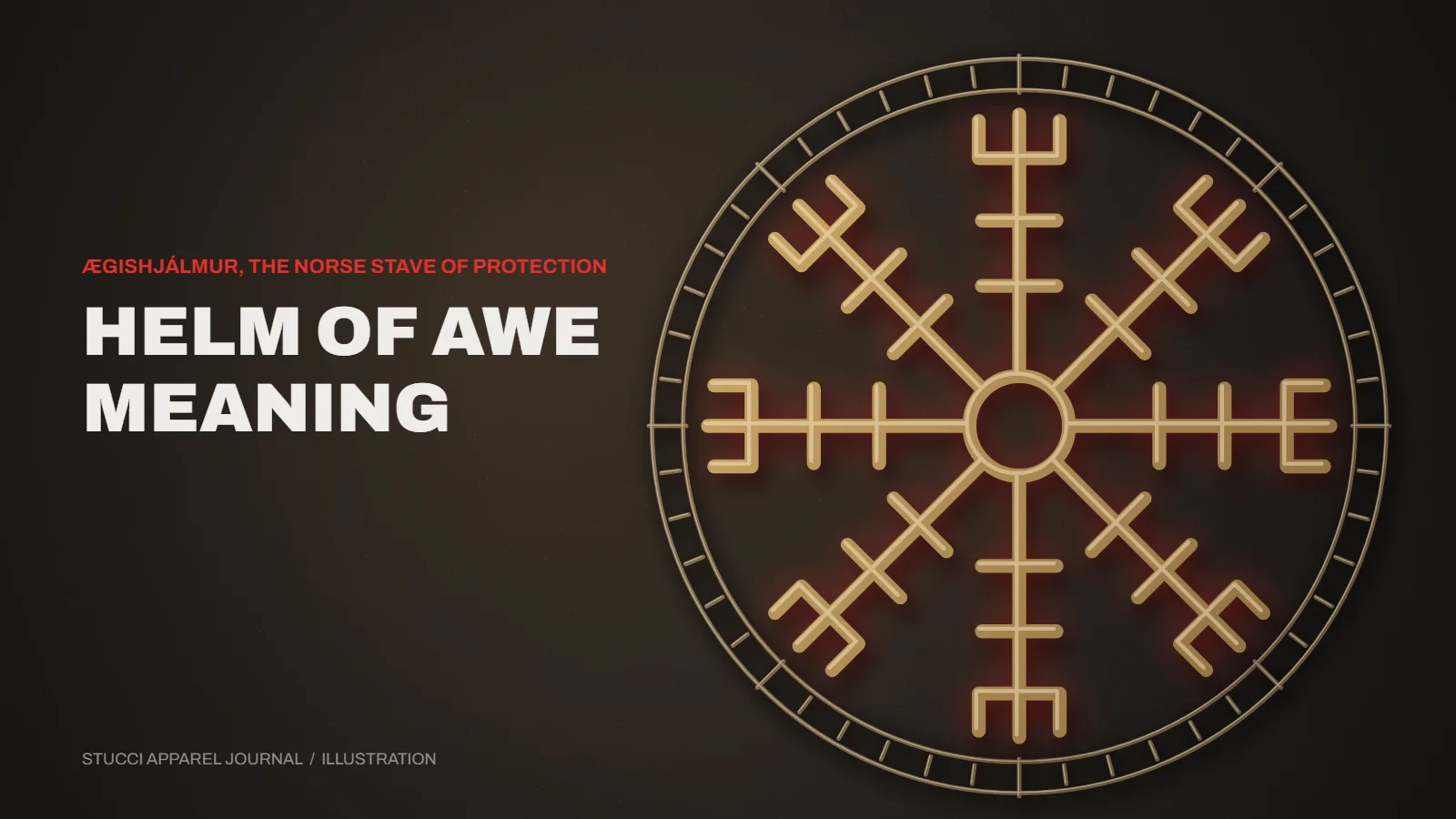
The Helm of Awe meaning comes down to one idea: protection that makes your enemies afraid before the fight even starts. Its Old Norse name, Ægishjálmur, shows up in the Poetic Edda on the head of a dragon guarding a mountain of gold, and centuries later the same name was given to a drawn stave in Icelandic spell books.
Today it is one of the most recognized Norse symbols on earth. Here is where it actually comes from, what the record shows, and what it doesn’t.
In this guide
Helm of Awe meaning at a glance
| Question | Short answer |
|---|---|
| Old Norse name | Ægishjálmur (also ægishjálmr) |
| Literal meaning | Helm of awe, or helm of terror |
| Earliest mention | The Poetic Edda, preserved in the Codex Regius, about 1270 |
| Earliest drawings | Icelandic spell books from the 1600s on |
| Traditional use | Protection and the upper hand over enemies |
| Viking Age artifact? | The name is in the old poems. No Viking Age drawing of the stave is known |
What does Ægishjálmur mean?
The name has two parts. The first comes from œgir, one who frightens, built on agi, the Old Norse word for awe or terror. The second, hjálmr, means helmet. Scholars usually translate the whole thing as helm of awe or helm of terror, and the standard reference summary notes both readings. So this is not a cozy good-luck charm. It is about being the thing other people fear.
That matters if you wear it. It isn’t a symbol of peace. It is a symbol of standing your ground so hard that the other side thinks twice.
In the Poetic Edda and the Völsunga saga
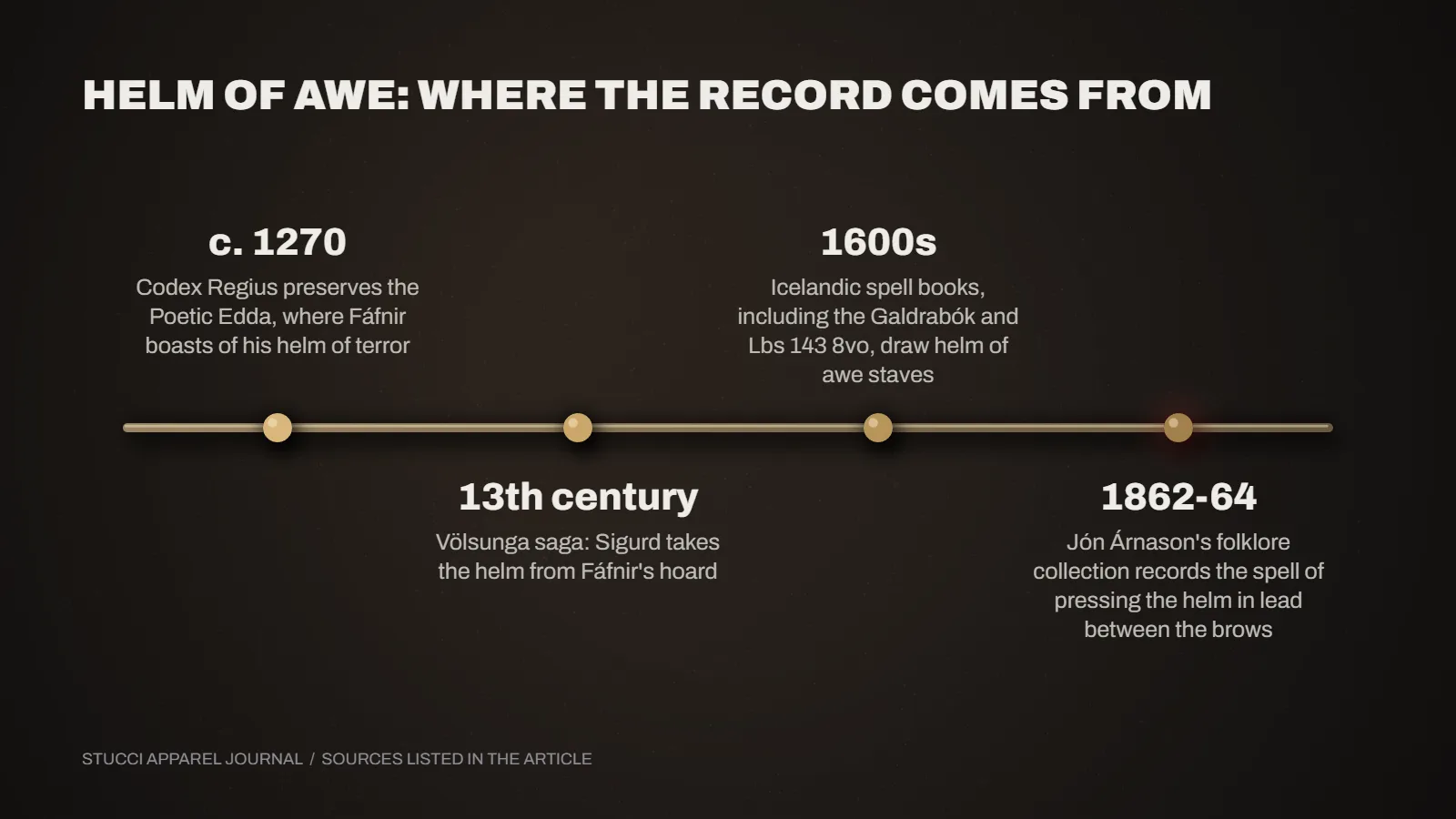
The oldest written appearance is in Fáfnismál, one of the heroic poems of the Poetic Edda. The dragon Fáfnir, dying from Sigurd’s sword, brags about the helm he wore while lying on his treasure. In Henry Adams Bellows’ 1923 translation, Fáfnir opens with a line that says it all: “The fear-helm I wore to afright mankind.” He claims it made him stronger than anyone.
Sigurd’s answer is the part most people skip. He tells the dragon that no helm protects a man who faces a truly brave enemy, and that the man who owns it gets hated more for it. In other words, the old poem already carries a warning: the helm buys fear, not invincibility.
The Völsunga saga, written down in Iceland in the 1200s, tells the same story in prose. After killing Fáfnir, Sigurd loads the dragon’s gold onto his horse, and the Ægishjálmur is part of the hoard he takes. In these sources the helm is an object, a piece of a hero’s loot. Nobody describes what it looks like.
From legendary helmet to drawn stave
The symbol you see on shirts and tattoos comes from much later Icelandic magic. Between the 1500s and the 1800s, Icelanders copied staves, called galdrastafir, into handwritten spell books. The Museum of Icelandic Sorcery and Witchcraft describes a 17th-century manuscript in the National Library of Iceland, Lbs 143 8vo, that includes an ægishjálmur stave with its own instructions, alongside protective seals (museum manuscript notes).
The Galdrabók, the best-known Icelandic grimoire, also from the 1600s, draws a four-armed version of the helm. Daniel McCoy at Norse Mythology for Smart People walks through that drawing and a later spell collected in Jón Árnason’s 19th-century folklore volumes.
In that spell, you shape the helm in lead, press it between your eyebrows and say a short formula about bearing the helm between your brows. The promise: you walk into a meeting with your enemies already holding the advantage.
What the design itself means
The familiar version has eight arms radiating from a center point, each ending in a trident-like fork, with crossbars along the arms. Eight arms point in every direction at once, which is why most readers take it as protection on all sides. There is no surviving medieval key that explains each stroke.
Some modern writers read the forked tips as variations of runes. Stephen Flowers, who translated the Galdrabók into English in 1989, connected the shapes to rune forms and described the helm as a sphere of power meant to strike fear into an enemy. Treat that as one scholar’s interpretation, not a code written down by the people who drew it.
Is the Helm of Awe a Viking symbol?
Straight answer: half yes. The name and the idea of a terror-helm belong to Norse legend, and the poems that mention it are older than the manuscript that saved them. But no Viking Age carving, coin or brooch shows the eight-armed stave. The drawings we have start in early modern Iceland, roughly 500 years after the Viking Age ended.
That doesn’t make it fake. It makes it Icelandic, a tradition that kept Norse names and stories alive and built new magic on top of them. The same is true of the Vegvisir, which often gets mixed up with it. If someone tells you a Viking raider wore this exact drawing into battle, they’re guessing.
How people wear it today
Today the Ægishjálmur is a tattoo, a pendant, a logo and a shirt. People wear it for the same reason the old spells used it: protection, and a reminder to walk in like you belong there. It shows up across Iceland on souvenirs, and Norse pagans and history buffs wear it worldwide.
If you wear it, wear it knowing the story. It is a dragon’s helmet in the Edda and a lead charm pressed to the forehead in Icelandic folk magic. Both versions are about the same thing: nerve.
Wear the Helm of Awe
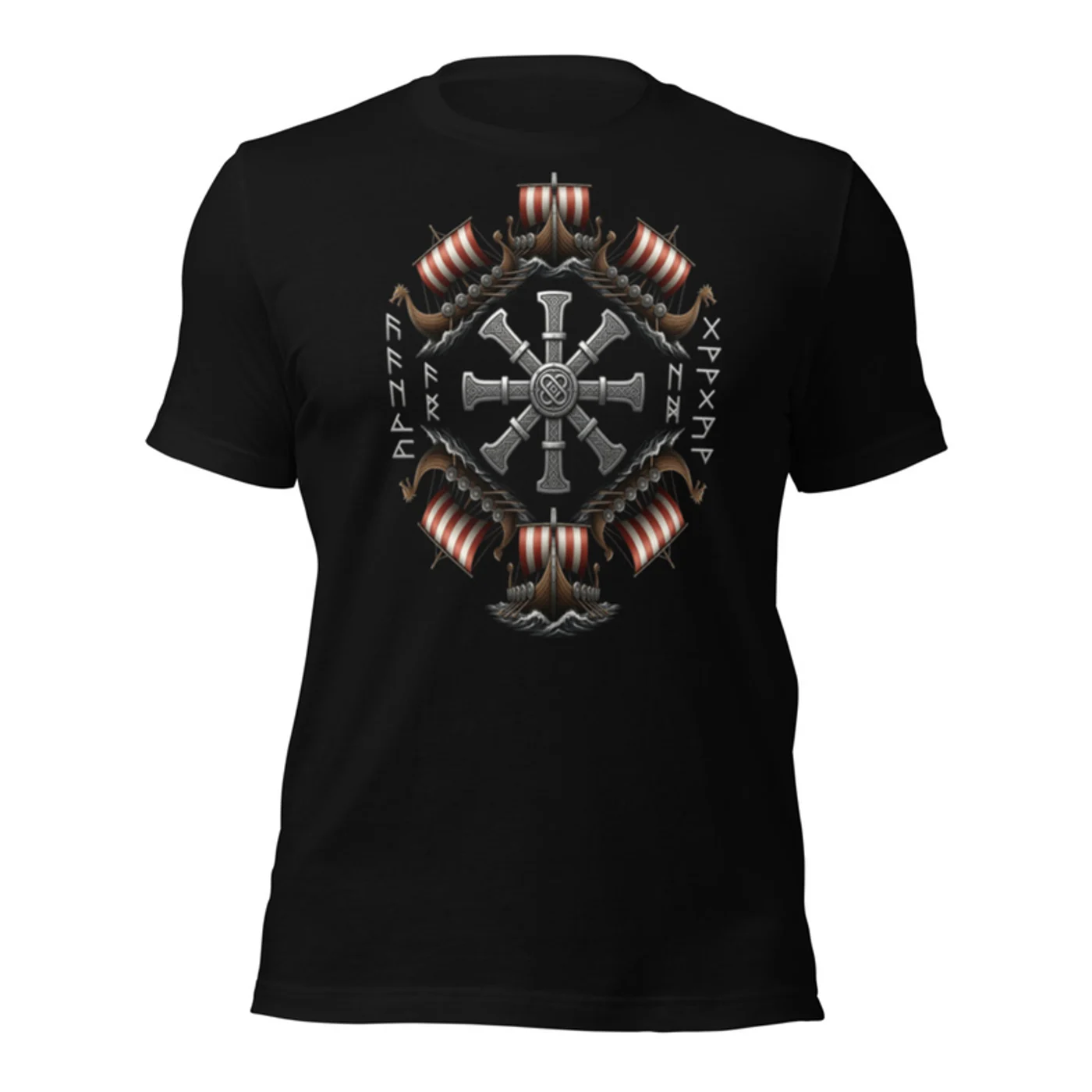
Our Helm of Awe Longship Tee puts the Ægishjálmur at the center of a full drakkar fleet, with runes bordering the piece. It is printed to order in the U.S. on ring-spun cotton in a unisex fit, XS to 5XL.
If that’s your speed, these sit right next to it:
- Vegvisir Wayfinder Tee: the wayfinder stave with wolves, ravens and a longship
- Odin’s Vegvisir Tee: the Allfather under the wayfinder, in grayscale
- Valknut Ravens Tee: the valknut from Gotland’s picture stones, with Huginn and Muninn
- Forged by Valhalla Tee: skull, horned helm and a ring of runes
- The full Viking collection
Helm of Awe FAQ
What does the Helm of Awe mean?
Ægishjálmur means a helm of terror or awe. In Norse legend it was a helmet that frightened everyone who saw it. In later Icelandic magic it became a drawn stave for protection and for gaining the upper hand over enemies.
Where does it come from?
The name comes from the Poetic Edda and the Völsunga saga, where the dragon Fáfnir owns it. The drawn symbol comes from Icelandic spell books from the 1600s onward.
Did the Vikings use it?
The name and legend are Norse. The stave itself is known from early modern Icelandic manuscripts, not from Viking Age artifacts.
How is it different from the Vegvisir?
The Ægishjálmur has eight matching trident-tipped arms and stands for protection and intimidation. The Vegvisir has eight different staves and is meant to keep you from getting lost.
Is it disrespectful to wear the Ægishjálmur?
No. It is widely worn in Iceland and around the world. Know what it means and wear it with intent.
Sources
- Fáfnismál, The Poetic Edda, trans. Henry Adams Bellows (1923), sacred-texts.com
- Helm of Awe, Wikipedia (etymology, Fáfnismál and Völsunga saga references)
- Daniel McCoy, The Helm of Awe, Norse Mythology for Smart People (Galdrabók and Jón Árnason spell)
- Museum of Icelandic Sorcery and Witchcraft, Icelandic manuscripts (Lbs 143 8vo)
- Stephen E. Flowers, ed. and trans., The Galdrabók: An Icelandic Grimoire (1989)
Stucci Apparel makes statement graphic tees printed to order in the U.S. We don’t do halfway, and that includes getting the history right.