
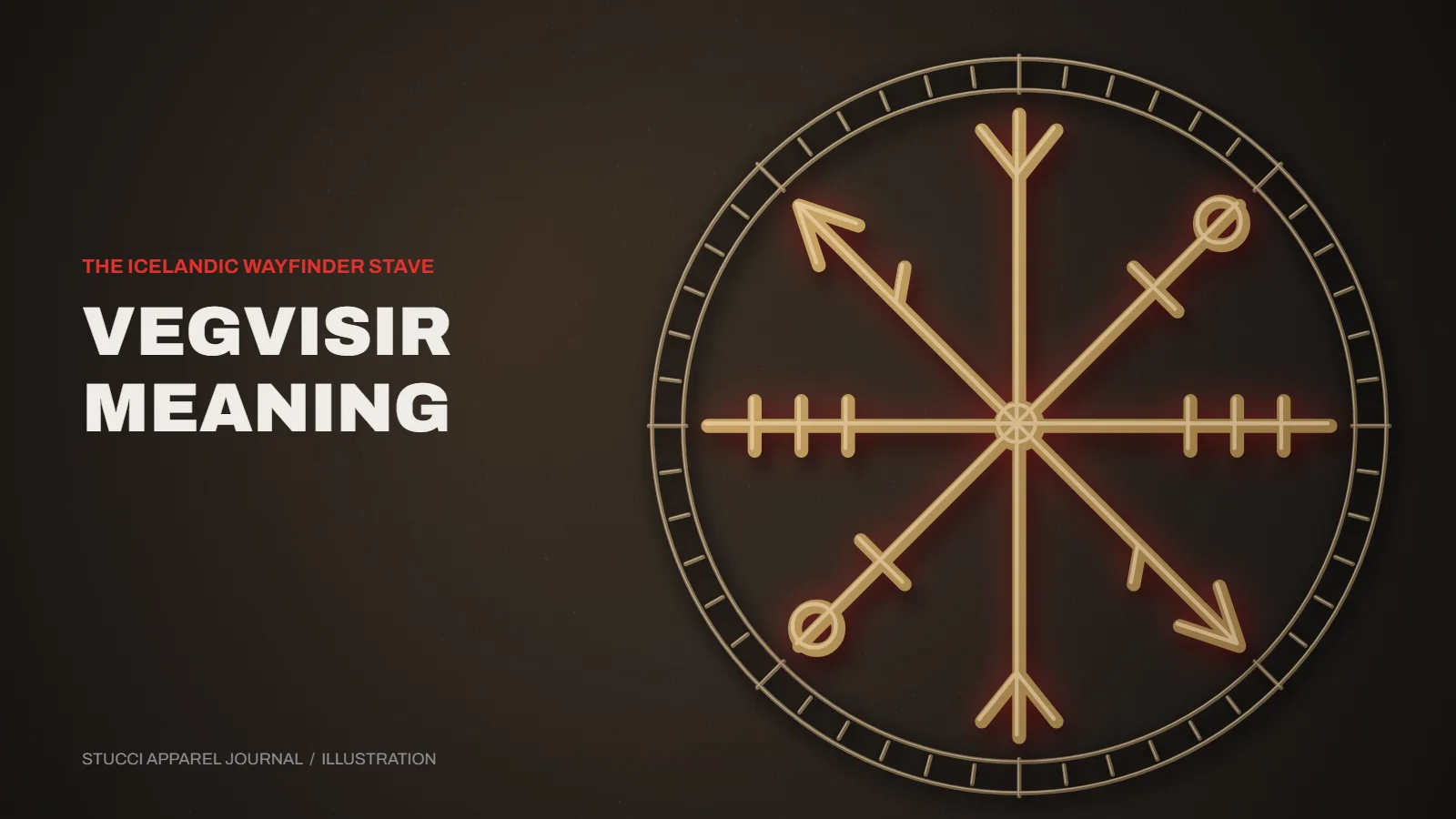
The Vegvisir meaning is right there in the name: way-shower, the thing that points you home. It is an eight-armed Icelandic stave that, according to the manuscript that preserves it, keeps the person carrying it from getting lost in storms or bad weather, even on a road they don’t know.
It gets sold everywhere as a Viking compass. The real story is more interesting than that, and it starts in a 19th-century Icelandic notebook, not on a longship.
In this guide
Vegvisir meaning at a glance
| Question | Short answer |
|---|---|
| Icelandic name | Vegvísir |
| Literal meaning | Way-shower, or wayfinder |
| Purpose | Keep the bearer from losing their way in storms and bad weather |
| Earliest record | The Huld manuscript, compiled by Geir Vigfússon in Akureyri, Iceland, in the mid-1800s |
| Viking Age artifact? | No. No example from the Viking Age is known |
| Often confused with | The Helm of Awe (Ægishjálmur) |
What does Vegvísir mean?
The word joins vegur, meaning way, road or path, with vísir, from the verb vísa, to show or point out. Wikipedia’s entry notes that related compounds exist in Danish, Swedish and German. So the meaning is plain and practical. It points the way.
That is a big part of its pull. Everybody has had a stretch of life where they could not see the road. A sign that promises you will find it anyway hits home.
Where it comes from: the Huld manuscript
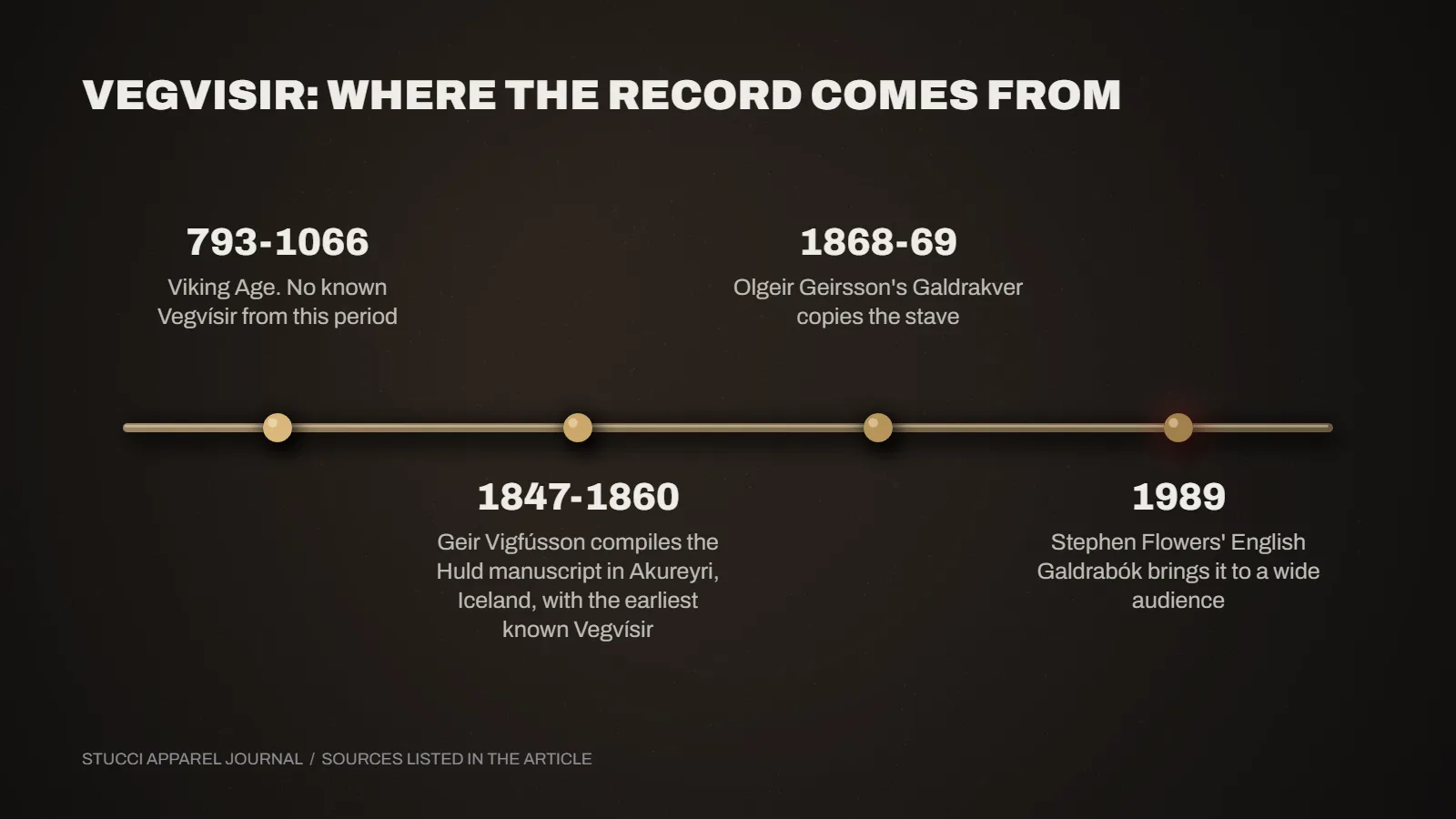
The earliest known example is in the Huld manuscript, catalogued as ÍB 383 4to and kept at the National Library of Iceland. It was compiled in Akureyri, in north Iceland, by a man named Geir Vigfússon. Most references, including Tomáš Vlasatý’s detailed study, date it to 1860. The Museum of Icelandic Sorcery and Witchcraft dates the compilation to 1847. Either way, it is a 19th-century book.
Huld is a collection of alphabets, secret scripts and about 30 magical staves, each with a short note. Next to the stave, the note gives one instruction and one promise. In Stephen Flowers’ English rendering, the bearer “will never lose one’s way in storms or bad weather.” That single line is the whole original description. Everything else you read about it is interpretation.
Vlasatý found the same stave in two more Icelandic grimoires, both called Galdrakver: one written by Olgeir Geirsson in 1868 and 1869, and an anonymous one from the Eyjafjörður area. He points out that the three books copy from one another, so they are not three independent witnesses. He also notes that one version ties the sign’s power to faith in God, in the name of Jesus.
Is the Vegvisir a Viking compass?
No, and anyone selling it that way is stretching. There is no wayfinder stave on any rune stone, ship, weapon or piece of jewelry from the Viking Age, which ran roughly from 793 to 1066. Daniel McCoy at Norse Mythology for Smart People puts it plainly: there is no evidence it was known or used then, and calling it a Viking symbol takes a leap of faith.
Vlasatý goes further. He traces the look of these Icelandic staves to European sigil magic, including Solomonic manuscripts with Christian roots, and argues the stave was created in Iceland. Others think older material may hide inside the later books. Nobody can prove a Viking Age origin, so we don’t claim one.
So why does it feel Norse? Because Iceland is where the Norse stories survived. The same culture that saved the Eddas and the sagas kept copying magic books for centuries. It is Icelandic folk magic, and that is a real heritage on its own.
What the eight arms mean
Look closely and every arm ends differently: forks, circles, bars and hooks. The Huld manuscript doesn’t explain any of them. It gives the whole sign one job, and that’s it.
Modern readers often treat the eight arms like the points of a compass rose, one for each direction, so the sign has you covered no matter which way the storm pushes you.
That reading makes sense of the design, but it is a modern idea, not something the manuscript says. The honest version: no key to the individual staves survives, and anyone who assigns a meaning to each arm is filling in the blanks.
What we do know is how these staves worked in Icelandic magic. They were drawn, carried or carved for one purpose at a time. This one’s purpose was to bring you back.
Vegvisir vs. Helm of Awe
These two get swapped constantly, even by tattoo shops. The Helm of Awe has eight identical arms ending in trident forks, and its job is protection and putting fear into your enemies. The wayfinder has eight different arms, each with its own shape at the tip, and its job is getting you where you are going. One is armor. The other is a map.
Why it is everywhere now
The symbol stayed obscure until English-language books on Icelandic magic, especially Flowers’ 1989 Galdrabók, put it in front of a wide audience. From there it spread through tattoo culture, the internet and Iceland’s souvenir shops. Singer Björk has a Vegvísir tattoo, which did plenty to make it famous.
Today people wear it before a move, a deployment, a deep-sea trip or a hard year. Sailors, travelers, veterans and anyone who has had to find their way back all claim it. That is a fair use of a sign whose only job was to keep you from getting lost.
Wear the Vegvisir
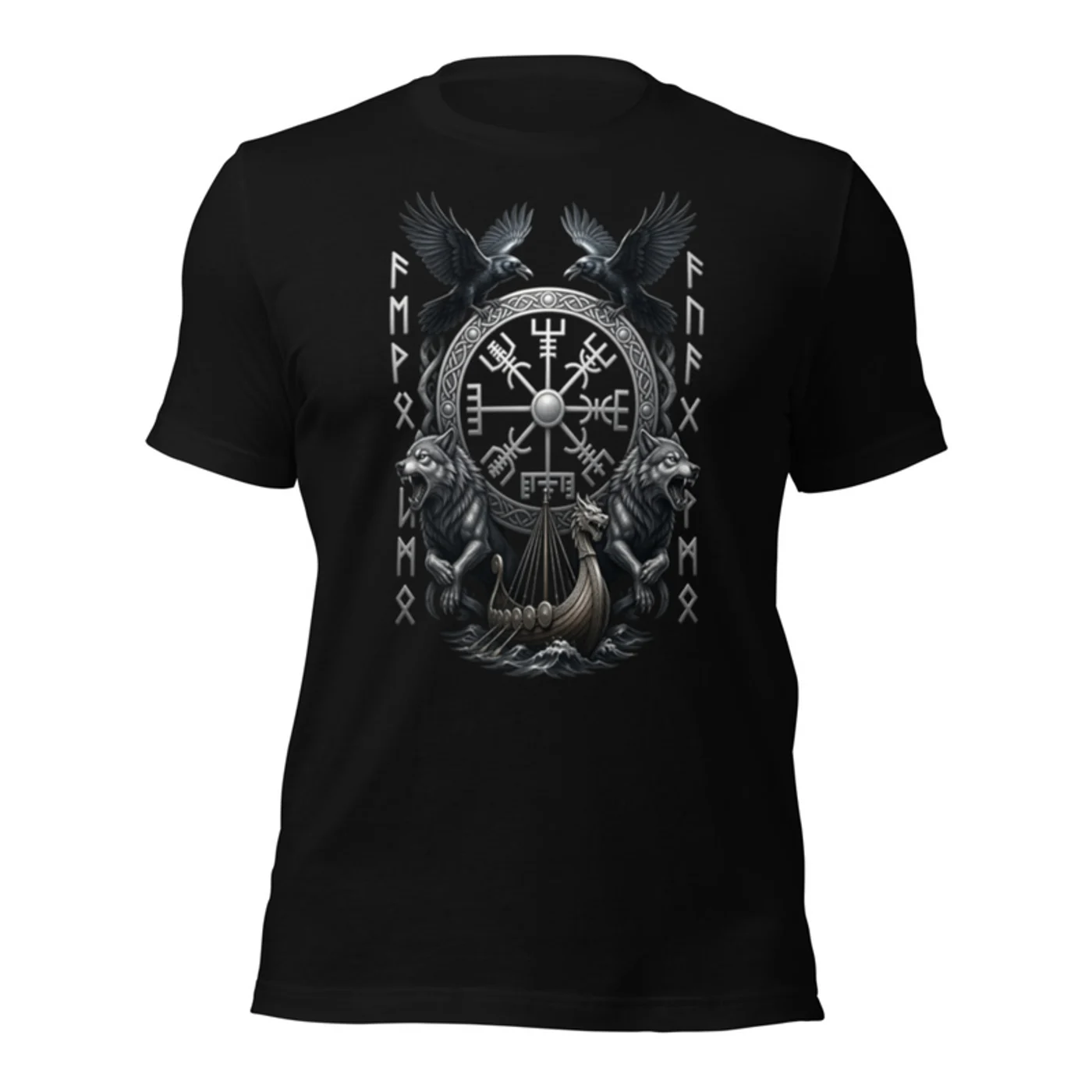
We make two takes. The Vegvisir Wayfinder Tee sets the stave over crouched wolves, watching ravens and a longship cutting dark water. Odin’s Vegvisir Tee puts the Allfather’s face beneath the wayfinder in grayscale, like ink on skin. Both are printed to order in the U.S. on ring-spun cotton in a unisex fit.
More from the same shelf:
- Helm of Awe Longship Tee: the Ægishjálmur inside a ring of longships
- Valknut Ravens Tee: three locked triangles with Huginn and Muninn
- Forged by Valhalla Tee: skull, horned helm and a ring of runes
- The full Viking collection
Vegvisir FAQ
What does the Vegvisir mean?
Vegvísir means way-shower or wayfinder. Its original note says the person who carries it will not lose their way in storms or bad weather, even when the way is unknown.
Is it Norse or Icelandic?
Icelandic. It is first recorded in the 19th-century Huld manuscript. Iceland’s culture grew from Norse roots, but no Viking Age example is known.
Did Vikings use it to navigate?
There is no evidence they did. It is a magical sign, not a working compass, and it shows up about 800 years after the Viking Age.
How is it different from the Helm of Awe?
The wayfinder has eight different staves and is about finding your way. The Helm of Awe has eight matching trident-tipped arms and is about protection and intimidation.
Is it okay to wear one?
Yes. It is worn widely in Iceland and around the world. Wear it knowing where it really comes from.
Sources
- Tomáš Vlasatý, Origins of the vegvísir symbol, Projekt Forlǫg (2019)
- Vegvísir, Wikipedia (etymology, Huld manuscript, Flowers translation)
- Daniel McCoy, The Vegvisir, Norse Mythology for Smart People
- Museum of Icelandic Sorcery and Witchcraft, Huld (ÍB 383 4to)
- Stephen E. Flowers, ed. and trans., The Galdrabók: An Icelandic Grimoire (1989)
Stucci Apparel makes statement graphic tees printed to order in the U.S. We don’t do halfway, and that includes getting the history right.