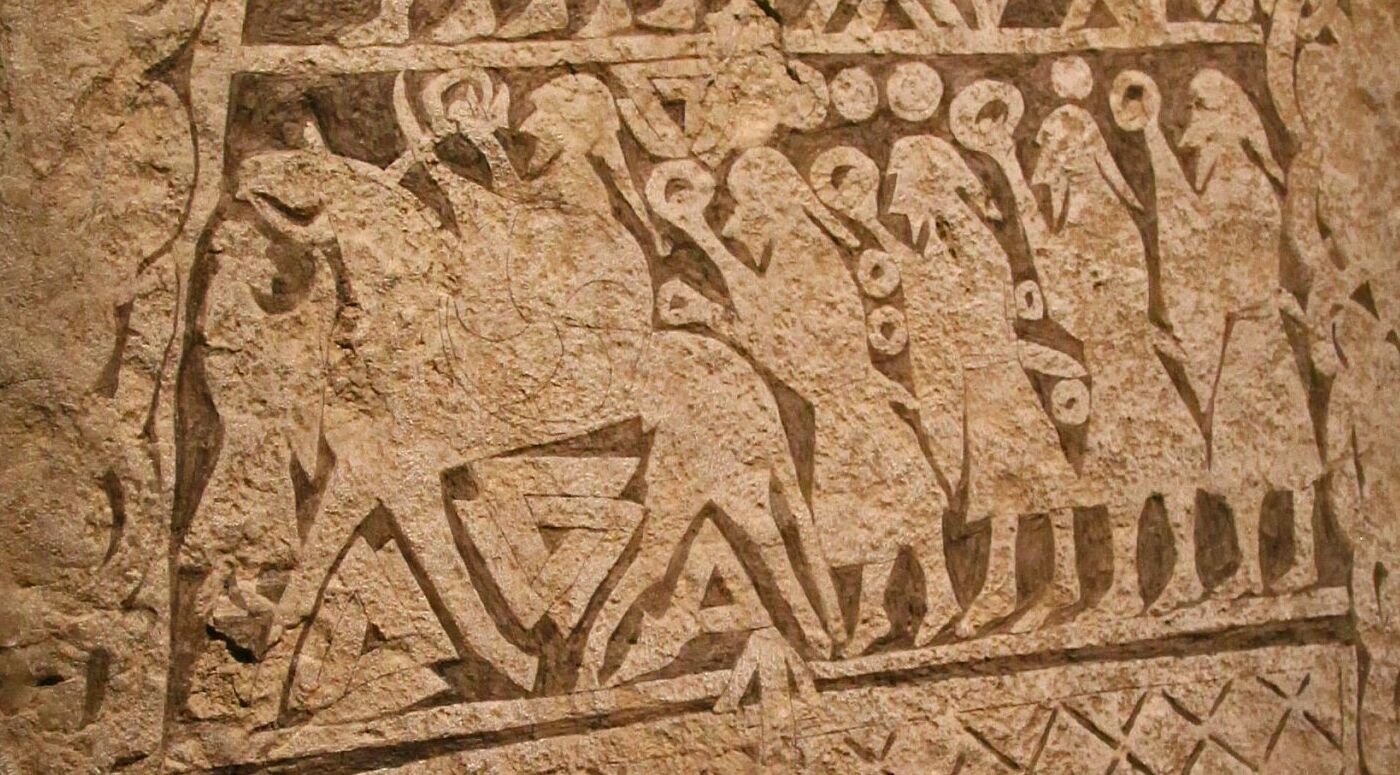
The valknut meaning is written on the stones themselves: three interlocked triangles carved next to Odin, the dead, and the road to Valhalla. Valknut is a modern Norwegian name usually read as “knot of the slain,” and the hall it points to, Valhalla, is where the old poems send warriors who fall in battle.
That is heavy stuff to put on your chest. So here is what the record actually says about the valknut, what Valhalla looked like in the sources, and where the guesswork starts.
In this guide
Valknut meaning at a glance
| Question | Short answer |
|---|---|
| What it looks like | Three interlocked triangles, drawn as one line or as three linked shapes |
| Name | Valknut, a modern Norwegian coinage. The Viking Age name is unknown |
| Literal meaning | Knot of the slain (valr, the fallen in battle, plus knut, knot) |
| Where it shows up | Gotland picture stones, the Oseberg ship burial, an Anglo-Saxon gold ring |
| Linked to | Odin, death in battle, and the journey to Valhalla |
| Valhalla | Odin’s hall of the slain, roofed with shields, home of the einherjar until Ragnarök |
What does valknut mean?
Start with the name, because it trips people up. Nobody knows what the Norse called this symbol. “Valknut” was coined in modern Norwegian from valr, the slain in battle, and knut, a knot. The same val sits at the front of valkyrie, the chooser of the slain, and Valhalla, the hall of the slain. The standard reference summary is clear that the old name, if it had one, is lost.
So the valknut meaning we use today is a reading built from where the symbol appears. And where it appears is consistent: around Odin, around the dead, and around warriors on their way out.
Where the valknut symbol appears
The best evidence comes from Gotland, the Swedish island in the Baltic, where people raised tall painted picture stones.
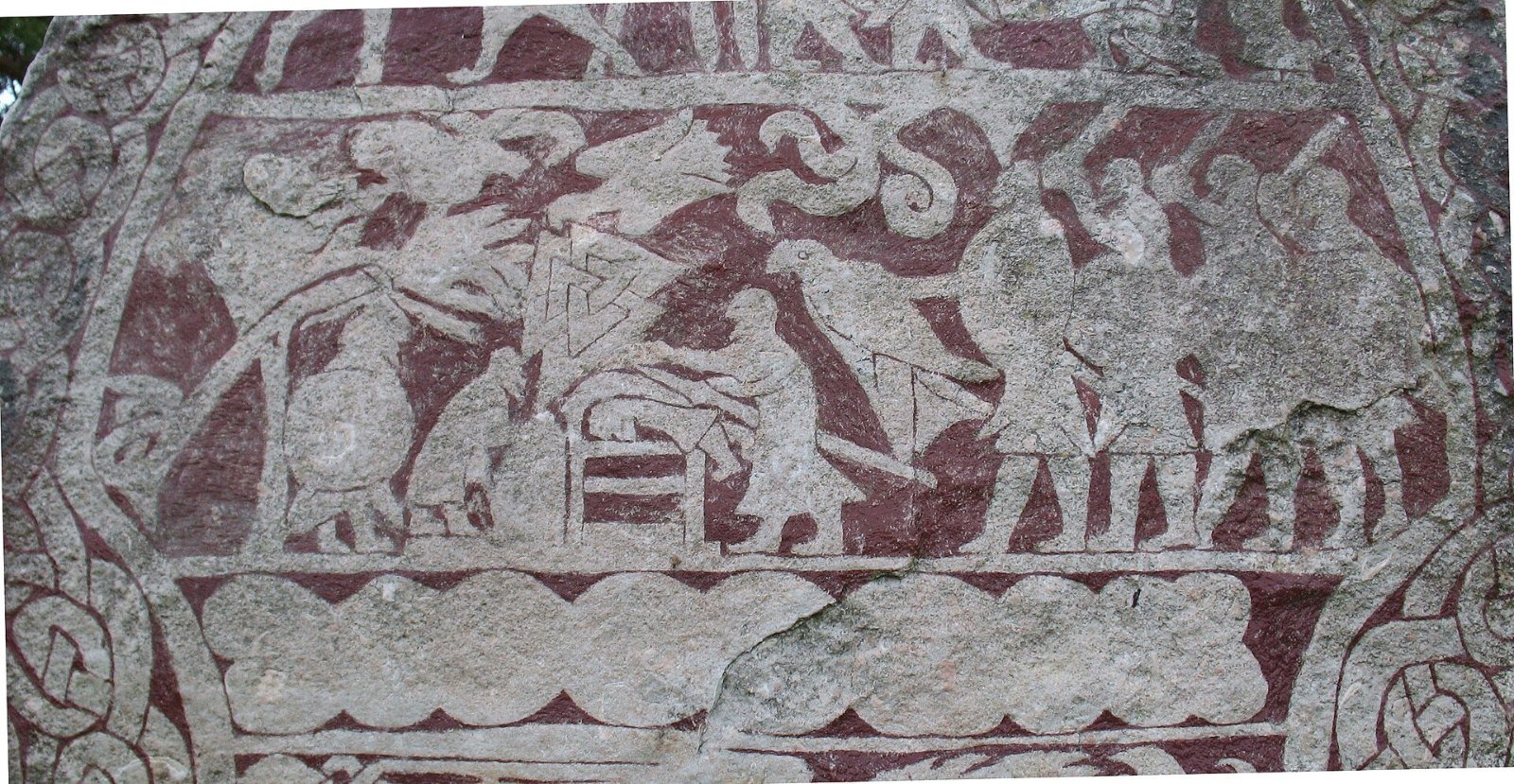
- Stora Hammars I, Lärbro parish. Usually dated to around the 8th century. In one panel a valknut hangs over an altar, next to a man being hoisted into a tree. Scholars read it as a sacrifice scene, and the valknut is treated as Odin’s cult sign.
- The Tängelgårda stone (pictured at the top of this guide). A rider on horseback is greeted by a figure holding a drinking horn while men with raised rings follow behind, and valknut symbols are carved around the horse. Most readers take it as a dead warrior arriving in the next world.
- The Oseberg ship burial, Norway. A carved bedpost from the famous ship grave carries a valknut. The burial is dated to 834.
- The Nene River ring. An Anglo-Saxon gold finger ring from about the 8th or 9th century with the symbol front and center.
Notice the pattern. Sacrifice, burial, a rider headed somewhere he won’t come back from. That is why nearly every serious reading of the valknut meaning ties it to death and to Odin.
Valknut meaning and Odin, god of the slain
Odin is the god who collects the dead worth keeping. In the Eddic poem Hávamál he hangs himself on a windswept tree for nine nights, wounded by a spear, to win the runes. A man in a tree under a valknut on Stora Hammars is hard to look at without thinking of that story, though the stone itself carries no caption.
Folklorist Hilda Ellis Davidson connected the symbol to Odin’s power to bind and unbind, including the power to bind a man’s mind. Rudolf Simek, an authority on Germanic religion, pointed to its placement on the Gotland stones and in the Oseberg grave and suggested it belonged to rituals around death. Treat both as informed interpretation of the valknut meaning. Nobody left a manual.
You’ll also see the valknut called Hrungnir’s heart. In the Prose Edda, Snorri Sturluson writes that the giant Hrungnir had a heart of hard stone with three sharp corners. Some people fold that into the valknut meaning and link it to the triangles. It is a modern comparison, not something Snorri said about the symbol.
Valhalla meaning: the hall of the slain
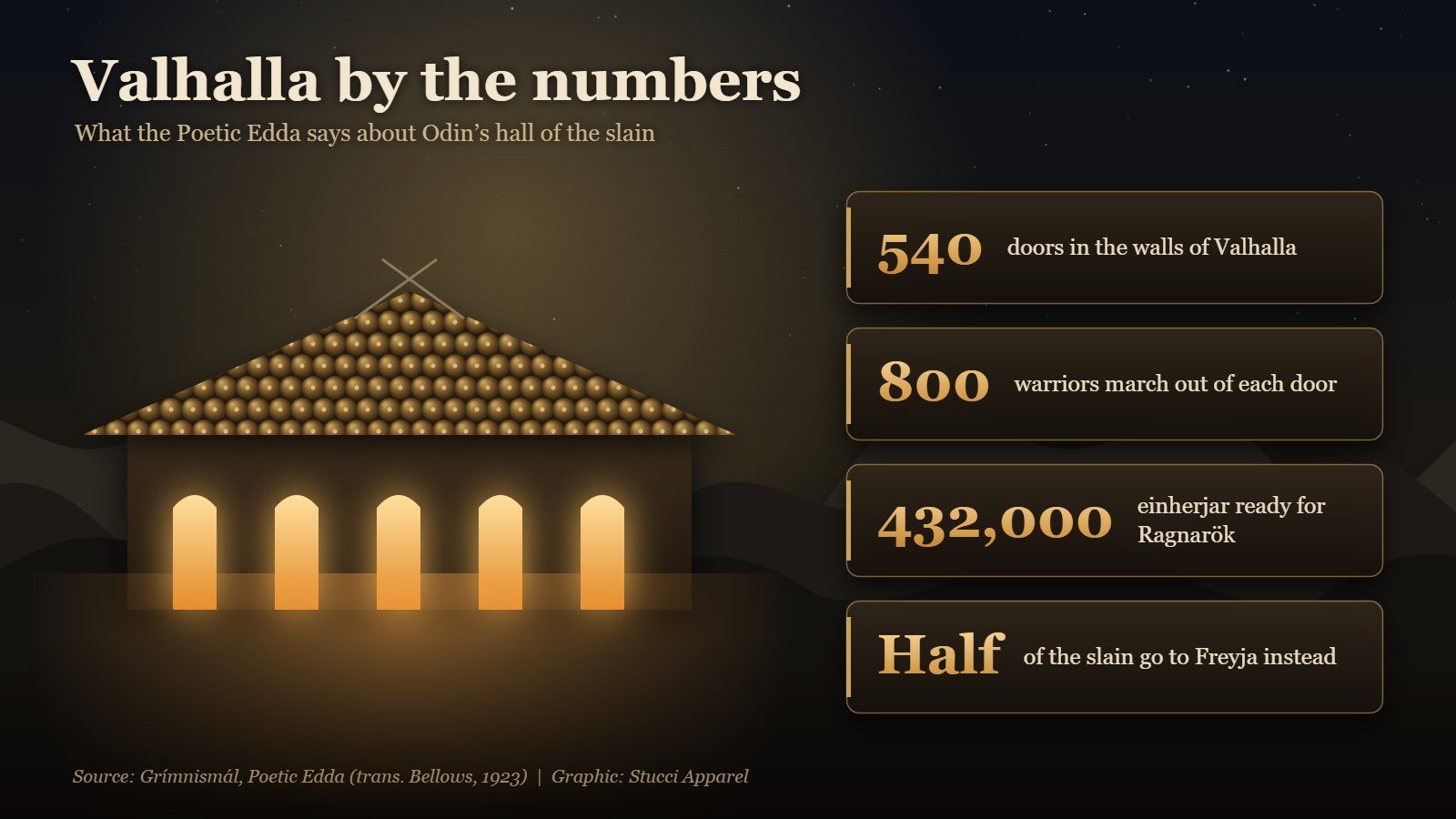
The Valhalla meaning is right in the name: Old Norse Valhöll, the hall of the slain. The richest description is in Grímnismál, a poem in the Poetic Edda where Odin, in disguise, lists the halls of the gods. In Henry Adams Bellows’ 1923 translation, Valhalla stands “gold-bright” in a realm called Glaðsheimr.
Here is what the poem puts in it:
- Rafters made of spear shafts, a roof of shields, and mail shirts thrown across the benches.
- A wolf hanging by the western door and an eagle hovering above it.
- Five hundred and forty doors, with eight hundred warriors marching out of each one when the last battle comes. Do the math: 432,000 fighters.
- The goat Heiðrún standing on the roof, eating from a tree and producing the mead the warriors drink.
Those warriors are the einherjar, the lone fighters. Snorri’s Gylfaginning, in the Brodeur translation of the Prose Edda, fills in daily life. Every day they arm up, go out and fight each other for sport, then ride home to drink together. The cook boils the boar Sæhrímnir every day, and by evening it is whole again. Odin himself eats nothing. He hands his meat to his wolves, Geri and Freki, and lives on wine.
Who goes to Valhalla, and why
The valkyries choose who dies in battle and who comes home with them. But Valhalla is not the only destination, and this is the detail most shirts and movies leave out. Grímnismál says the goddess Freyja picks half of the slain each day for her own field, Fólkvangr, and Odin gets the other half.
Odin isn’t running a retirement home either. He is building an army. As Britannica summarizes, the einherjar will fight beside him at Ragnarök, the final battle. Every day of sparring in Valhalla is training for a fight the gods know they are going to lose. They show up anyway.
That is the part of the valknut meaning that hits. Valhalla is not a reward for winning. It is a reward for how you went down, and the deal is that you keep showing up for the next fight.
Does the valknut mean you are ready to die?
For some people the valknut meaning is exactly that: a pledge to Odin, a promise to go out on your feet. That reading fits the stones. Plenty of others wear it for the whole package, the old gods, the warrior code, and the reminder that nobody gets out alive, so you’d better live like it.
One straight note. The Anti-Defamation League lists the valknot in its hate symbol database because some racist groups have adopted it. The same ADL entry says non-racist pagans use it too and that context decides what it means. We’re with the people who carved it 1,200 years ago. Know the history, wear it with intent, and don’t let anyone hijack it.
Valknut vs. Helm of Awe vs. Vegvisir
People mix these three up constantly, so here is the valknut meaning next to the other two. The valknut is the only one of them carved on Viking Age stones. The Helm of Awe is a protection stave named in the old poems but drawn in Icelandic spell books centuries later. The Vegvisir is an Icelandic wayfinder stave from the 1800s. Different eras, different jobs: the valknut is about death and Odin, the Helm of Awe about protection and fear, the Vegvisir about not getting lost.
And one more myth to kill: horned helmets. They look great on a skull graphic, and we print them, but real Viking warriors didn’t wear them. The only reasonably complete Viking Age helmet ever found, from Gjermundbu in Norway, is a plain iron cap with a spectacle guard.
Wear the valknut and Valhalla
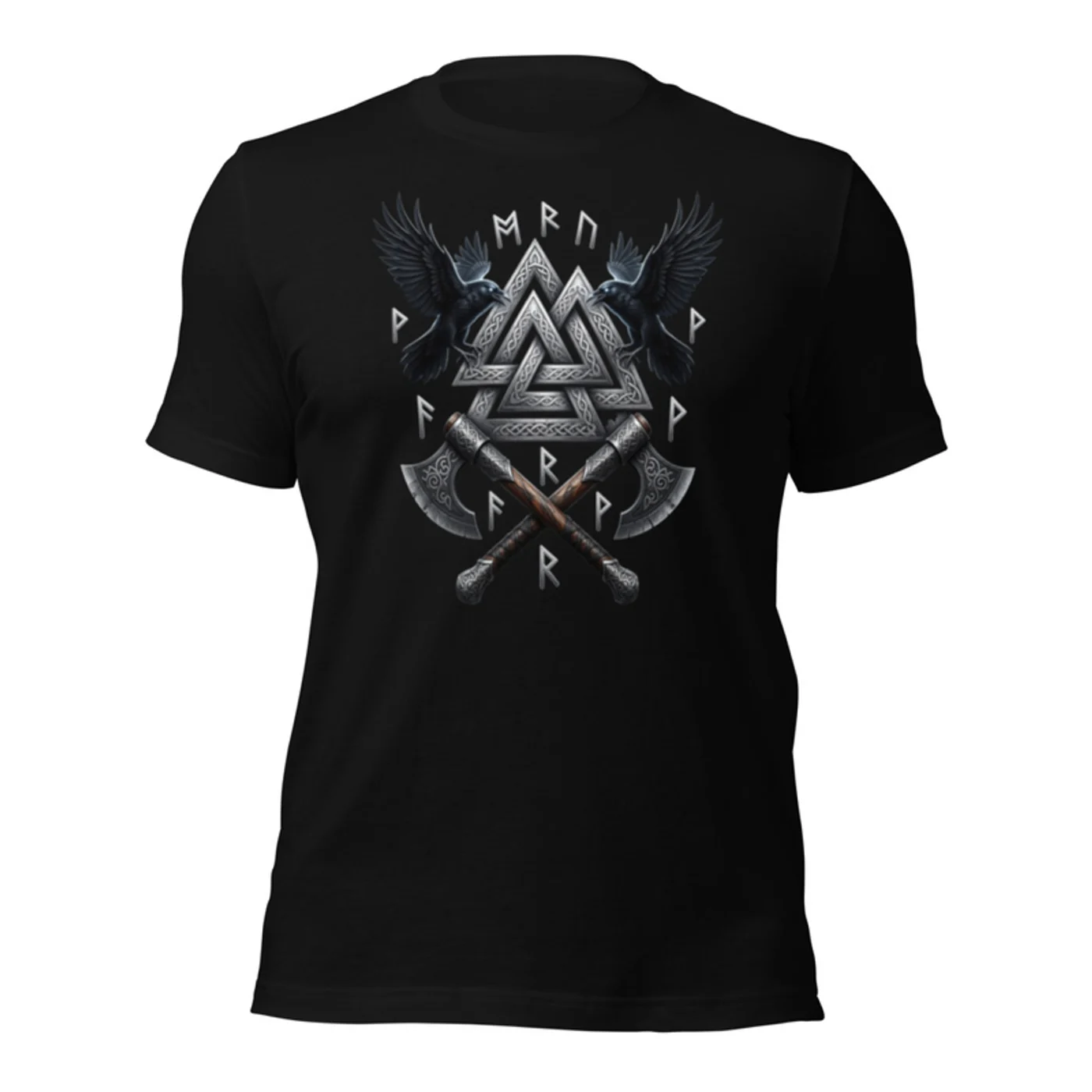
Our Valknut Ravens Tee puts the knot of the slain in the center with Huginn and Muninn, Odin’s ravens of thought and memory, on either side and crossed axes below. Printed to order in the U.S. on ring-spun cotton, unisex fit, XS to 5XL.
Built for the same crowd:
- Valhalla Skull Tee: horned helm, a ring of runes and crossed axes on a heavyweight black tee
- Forged by Valhalla Tee: a battle-worn skull wearing the hall like a war crest
- Iron Will Wolf Tee: a helmed wolf for anyone who runs with their pack
- Helm of Awe Longship Tee: the Ægishjálmur over a full longship fleet
- The full Viking and Norse mythology collection
Valknut meaning FAQ
What is the valknut meaning in Norse mythology?
The name means knot of the slain. The symbol appears on Viking Age stones and in burials next to scenes of sacrifice and death, so it is linked to Odin and to warriors who die in battle.
Is the valknut a real Viking symbol?
Yes. It is carved on Gotland picture stones from around the 8th century and on a bedpost from the Oseberg ship burial of 834. Only the name is modern.
What is Valhalla in Norse mythology?
Valhalla is Odin’s hall of the slain, with a roof of shields and rafters of spears. Warriors chosen by the valkyries feast and train there until they fight beside Odin at Ragnarök.
Did every warrior go to Valhalla?
No. Grímnismál says Freyja takes half of the slain to her field, Fólkvangr, and Odin takes the other half.
Is the valknut a hate symbol?
Not by origin. It is a Norse symbol more than a thousand years old. Some extremists have adopted it, and the ADL says to judge it by context, since pagans and history fans wear it with no racist meaning.
Sources
- Grímnismál, The Poetic Edda, trans. Henry Adams Bellows (1923), sacred-texts.com
- Gylfaginning, The Prose Edda, trans. Arthur Gilchrist Brodeur (1916), sacred-texts.com
- Valknut, Wikipedia (name, Gotland stones, Oseberg, Nene River ring, Davidson and Simek)
- Valhalla, Encyclopaedia Britannica
- Valknot, ADL Hate Symbols Database
Top photo: the Tängelgårda picture stone by JC Merriman, Wikimedia Commons, CC BY 2.0.
Stucci Apparel makes statement graphic tees printed to order in the U.S. We don’t do halfway, and that includes getting the history right.